It’s been getting rather cold recently, and Mary had bought a load of wine so I thought I’d rig up some temperature sensors to neon (the server) and have it monitor and plot some graphs so we can see how the temperature varies over time. I read that the ideal temperature for wine is 12°C, so, from the graph, we can see that to store wine in the larder long term, we would need to have some sort of (cheap) background heating in there.
It’s quite clever as the sensors work off of a 1-wire bus. Well, you need a ground, so it’s only two wires. You connect them ( loads of them ) all in parallel and connect it to the controller. The controller sends a pulse down the bus and the sensors have a capacitor to store up this charge and then reply with its temperature, attached to its own unique ID, so the controller can tell which is which. I’ll eventually have the sensors all over the house and I can see a project getting it to control the central heating, such that the heating comes on and switches off optimally for comfort and energy consumption.
Most of the time was taken in routing the wiring to the sensors. Will put in some permanent wiring for more sensors when we have the floorboards up.
As you can see, it’s been getting colder …
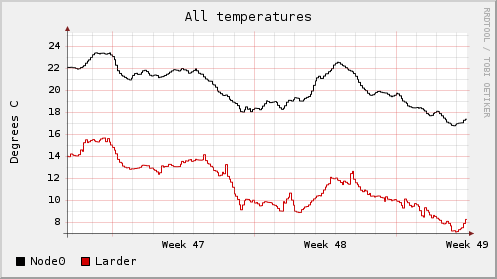
“Node0” is the server room. Also interesting is the spikes in the temperature in the larder when we open the door to it to get a snack.
The sensor I used is the DS18B20 made by Maxim. I bought mine from HomeChip. Very good company.
The controller I used to connect them to the server is the DS9490R, again made by Maxim. Again, HomeChip
I used RJ11 connectors and some spare telephone cable I had lying around to connect them.
I run linux so I used OWFS to interact with the hardware. I’m sure there’s something for windows out there.
“…to store wine in the larder long term, we would need to have some sort of (cheap) background heating in there”.
Sounds like a lot of hassle for few cases of Blue Nun?